βœ‰οΈ rankandrent2+water-damage-tennessee@gmail.com
Nashville, TN Β· Cumberland River Region Β· Statewide Referral Network

Structural Drying & Dehumidification in Tennessee

Drying is the phase that decides whether a water job ends or lingers. One call connects you with a local pro who dries by the readings β€” air movers, dehumidifiers and a moisture log that proves the structure is dry.

πŸ’§ Water in your home right now?

Talk to the Tennessee team

Tell us what got wet, when, and whether extraction is done. We match the job with a local pro, and the pro confirms the drying scope with you before equipment is placed.

πŸ“ž Call Now Prefer email? Write to us β†’

No forms, no obligation. A referral service β€” not a direct service company.

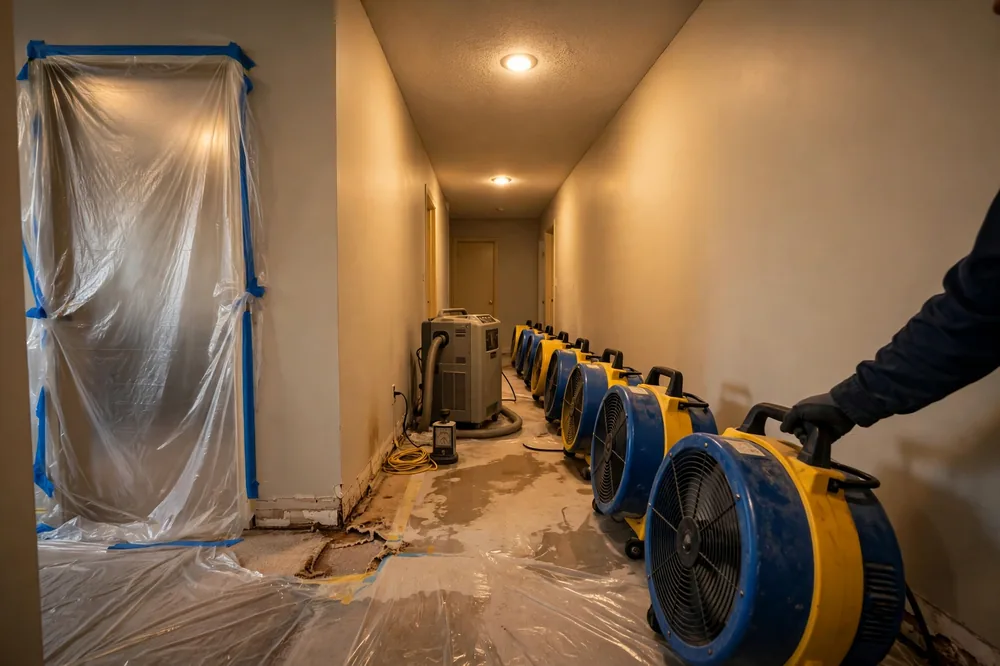
Air movers and dehumidifiers set up to dry a Tennessee home after water damage
Dry, verified

Understanding Structural Drying in Tennessee

A room can look dry and still be wet where it counts. Structural drying is the discipline of removing moisture from the building itself β€” studs, plates, subfloors, joists, the backs of drywall β€” and proving it with instrument readings. It uses evaporation and dehumidification in balance: air movers strip moisture from surfaces into the air, and dehumidifiers pull it out of the air so the cycle keeps moving in one direction.

Tennessee makes drying harder than the equipment brochures suggest. For much of the year the state's air arrives pre-loaded with humidity, so a wet structure in Memphis, Nashville or Knoxville is drying into air that does not want the water. Uncontrolled drying β€” windows open, fans running β€” can stall entirely in a humid week. Controlled drying, with the space contained and dehumidification sized to the load, works regardless of the weather outside, which is precisely why the professional version exists.

The log is the product. A drying job is finished not when the fans have run a set number of days but when readings at the original wet points reach a dry, stable range comparable to unaffected material. That discipline protects everything downstream: repairs that do not trap moisture, a home without the musty sequel, and a claim file that shows its work.

  • Equipment placed from moisture readings, not guesswork
  • Cavities and floor systems dried, not just room surfaces
  • Readings logged at the same points on every visit
  • Dry declared by numbers β€” comparable to unaffected material
What is covered

What Our Structural Drying Service Includes

A controlled drying system, monitored until the log says done.

Moisture mapping and drying plan

The structure is metered throughout β€” walls, floors, cavities, framing β€” and the equipment plan is drawn from that map, room by room.

Air mover placement

Movers are angled and counted to sweep every wet surface, creating the evaporation the dehumidifiers then capture. Placement is a pattern, not a pile of fans.

Dehumidification sized to the load

Refrigerant or desiccant units are matched to the volume of water being evaporated, and their output is checked β€” gallons removed are part of the log.

Cavity and floor-system drying

Wall cavities, crawl-space framing and floor systems get directed air through small ports or mats, so hidden moisture is dried, not abandoned.

Daily monitoring and adjustment

Return visits re-read the same points, move or remove equipment as areas reach dry, and catch the spots that lag before they become problems.

Final dry verification

The job closes when readings across the map sit in a normal, stable range β€” documented, and available for your records and your claim.

Step by step

Our Structural Drying Process

Five steps from wet map to verified dry.

Describe what got wet and when extraction happened. Drying follows extraction in the same job wherever possible, so no moisture day is wasted between phases.
Meters draw the wet map; unaffected material gives the dry target. Equipment count and placement follow from those two facts.
The drying zone is contained, movers and dehumidifiers are placed, and initial readings are logged at every point that will be tracked.
Daily checks compare each point to target. Equipment is repositioned toward the laggards and removed from areas that have arrived, so the system finishes as a whole.
Final readings across the map confirm dry. Equipment comes out, the log is closed, and repairs β€” if any β€” are cleared to begin.
Tools & methods

Tools & Methods for Structural Drying

Evaporation, capture and measurement β€” the three legs of the stool.

Air movers in a designed pattern

Low-profile movers are placed to keep a sheet of air moving across every wet surface at the right angle. The pattern is what dries a room evenly instead of in stripes.

Dehumidifiers matched to the load

Oversized for the first days, then stepped down as the load falls β€” capacity follows the evaporation rate, and condensate output is tracked as evidence of progress.

Meters that keep everyone honest

Pin meters read inside wood and drywall; pinless meters scan whole walls; humidity sensors watch the air itself. Together they replace opinion with a log.

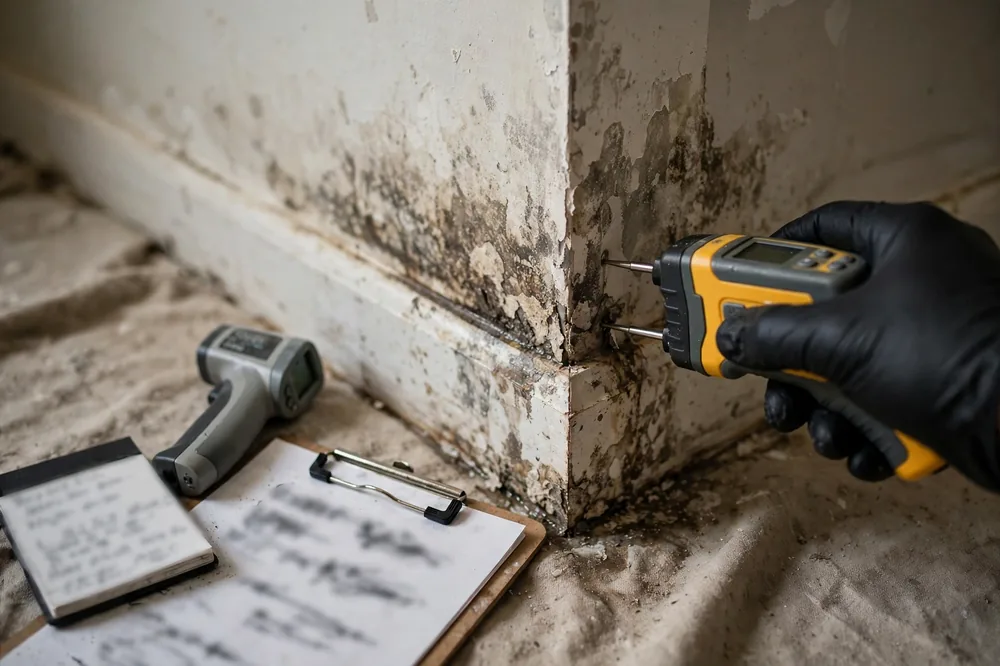
Technician checking wall moisture with a meter during a Tennessee water damage inspection
Change you can see

Before and after.

How drying changes what eyes cannot judge.

Before

Wall that feels dry to the touch

Surface reads fine while the cavity behind it holds moisture against the studs.

After

Wall verified dry through the cavity

Cavity air dried the studs and the back of the drywall; readings match the unaffected wall nearby.

Before

Hardwood floor after extraction

Boards look recovered but the subfloor beneath is still releasing moisture.

After

Floor system at target readings

Drying mats and balanced dehumidification brought boards and subfloor to a stable, dry range together.

Before

Basement after pumping

Concrete floor looks dry; the bottom plate and wall bases are still wet.

After

Basement box fully dried

Air moved along the walls and dehumidification ran until framing and masonry read dry and stable.

Problems Solved by Our Structural Drying Services

Drying exists because moisture left behind does not stay quiet.

01

Mold growth inside closed construction

Wet cavities in a humid state are mold's preferred address. Verified drying inside walls and floors removes the condition mold needs, before colonies establish.

02

Repairs that trap the problem

Drywall and flooring installed over damp structure seal moisture in and fail early. Drying verified before close-up is what makes repairs permanent.

03

The musty smell that never leaves

Homes that were 'dried' by fans alone often keep a damp odor for years β€” the signature of moisture still in the structure. A logged, metered dry is the actual cure.

πŸ“ž Call Now

Scope factors

What Decides the Scope of a Drying Job

Load, materials and air decide the system size and the days.

Volume of water in the structure

A soaked wall section and a whole wet floor system evaporate very different loads. Load sizes the dehumidification and predicts the timeline.

Materials and assemblies involved

Hardwood over subfloor, tile over backer, plaster over lath β€” each assembly releases water at its own rate and needs its own approach.

Hidden moisture locations

Cavities, crawl spaces and layered floors add directed-air work and monitoring points beyond the visible rooms.

Ambient humidity and containment

A Tennessee summer raises the difficulty of every drying job. Containment and capacity are how the plan answers the weather.

Good questions

Structural Drying Questions

Timelines, equipment and how dry gets proven.

Ask Your Question

Most residential jobs run three to five days of monitored drying after extraction; heavy loads, layered floors and wall cavities can extend that. The honest answer lives in the log: each tracked point has a target, and the job ends when the points arrive, not when a preset number of days passes. Your pro can give a range after the first mapping, and the daily readings will show whether you are on it.
For a small, surface-level spill caught immediately, home equipment can be enough. For water that has entered walls, floors or a basement structure, the gap is capacity and measurement: consumer dehumidifiers remove a fraction of what the load requires, and without meters you cannot know whether the cavity dried or only the surface did. The jobs that come to this service after a DIY attempt usually cost more drying time than the ones that started professionally.
Drying is a continuous physical process β€” evaporation into moving air, captured by dehumidification. Stopping at night lets surfaces re-absorb moisture from the humid air the day's work produced, and in Tennessee's climate that setback is real. Round-the-clock running is what compresses the job into days instead of weeks, and the equipment is designed to run unattended.
When the moisture log says so: readings at every originally wet point sitting in the same range as comparable unaffected material, stable across a final check. Ask to see the log and the comparison points β€” a professional expects the question and keeps the records exactly so it can be answered with numbers instead of reassurance.
Keep exploring

Related Services

Nine other ways the network helps Tennessee homes after water gets in.

One call starts it

Need Structural Drying in Tennessee?

Tell us what got wet and when. We will match your job with an independent local water damage professional who serves your city.

πŸ“ž Call Now
Get in touch

Contact Us for Structural Drying & Dehumidification

Calls are the fastest route β€” water does not wait for inboxes. Email works too if the situation is stable and you are planning ahead.

πŸ“ž

Call β€” describe the job

One call is the whole intake: where the water is, what caused it, when it started. We match the job locally from there.

πŸ“ž Call Now
βœ‰οΈ

Email the details

Stable situation, planning ahead? Send photos and a short description and we will line up the right local pro.

rankandrent2+water-damage-tennessee@gmail.com
πŸ•–

Hours β€” Central Time

Mon–Fri 7 AM–10 PM Β· Sat 8 AM–10 PM Β· Sun 7 AM–9 PM (Central Time). Water does not keep office hours, and neither does the damage it causes β€” call as soon as you find it inside those hours and we will get the match moving.

See service areas β†’

One call, and the match is made

Tell us what happened once. An independent local water damage professional confirms the scope and the cost with you before any work begins β€” no obligation, no pressure.

πŸ“ž Call Now
πŸ“žWater damage?Call Now